Mobility
Siwi World integrates the Unitsky String Technologies (uST) system to provide revolutionary solutions to key challenges in modern mobility:
- Lack of efficiency
- Sustainability issues
- Safety vulnerabilities
- High infrastructure costs
uST is not just a mobility technology; it is an advanced engineering solution that offers:
- Resource efficiency
- Environmental protection
- Optimized land use
- Digital integration
R&D Centers
📍 Eco Techno Park – Maryina Gorka, Belarus
A site for R&D, testing, certification, demonstration, and sales of mobility solutions.
📍 uSky Test & Certification Center – Sharjah, UAE
An advanced testing and research center tailored for tropical climate conditions.
Structural Components
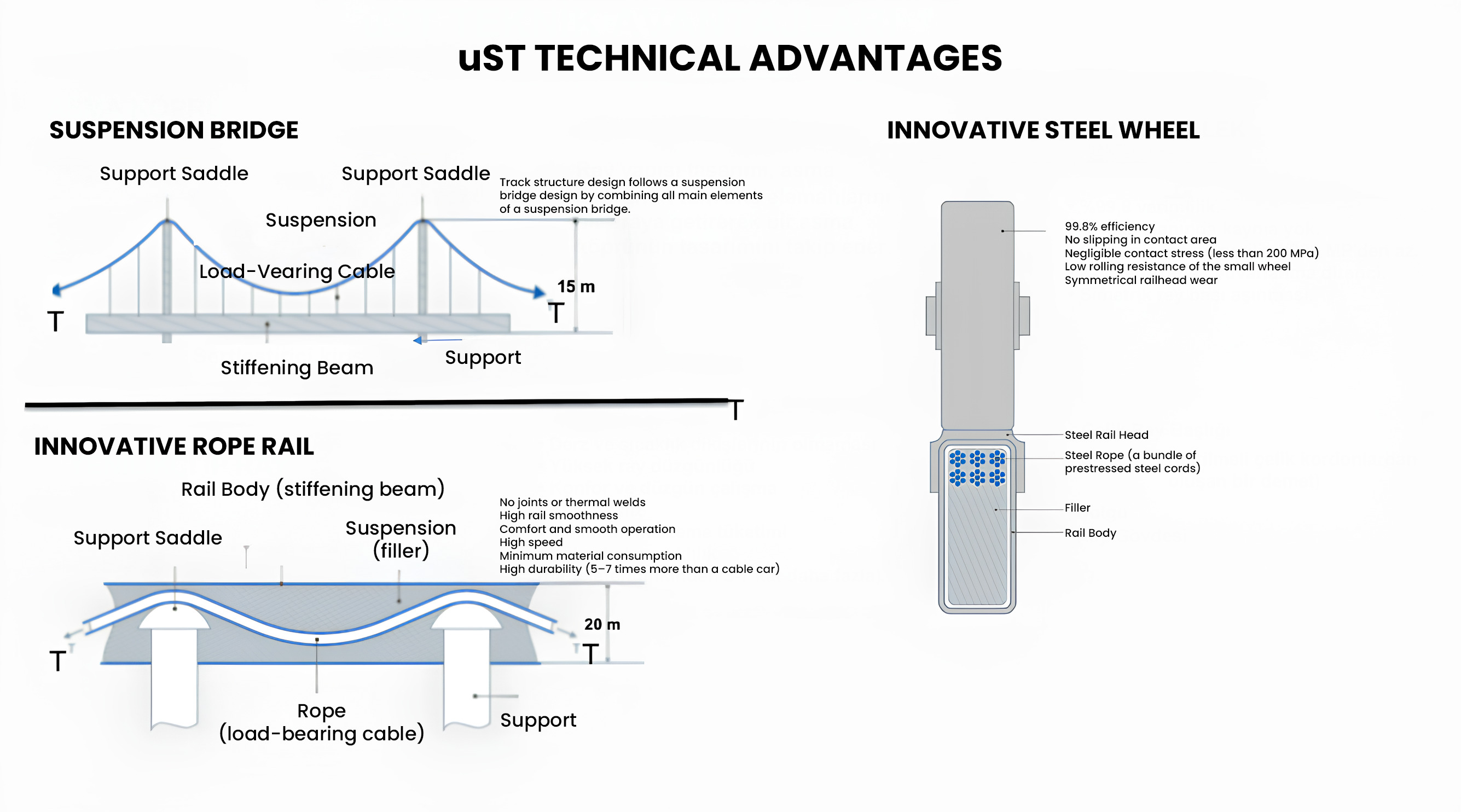
Elevated Rail Infrastructure
In the uST system, the rail structure is supported by:
-
Prestressed steel cables
-
Reinforcing beams operating on a suspension bridge principle
-
It allows spans up to 1,000 meters
-
Transports loads without touching the ground, which means:
- Natural landscapes remain intact
- Ecosystems are preserved
Unmanned Electric Vehicles
The system uses vehicles that are:
- Fully electric
- Run on steel wheels with 99.8% efficiency
- Driverless, powered by automated control systems
Three Main Vehicle Types:
- Urban passenger mobility – up to 150 km/h
- High-speed intercity mobility – up to 500 km/h
- Freight/container mobility – up to 100 million tons/year
Automated Control System
Using AI and big data, the system:
- Analyzes passenger flow
- Optimizes traffic
- Manages fleet distribution
- Predicts maintenance needs
- Offers blockchain integration and is quantum computing-compatible for high-level security
Technical Performance
| Feature | Value |
|---|---|
| Max speed | 500 km/h |
| Urban passenger capacity | 25,000 passengers/hour |
| Intercity passenger capacity | 250,000 passengers/day |
| Freight capacity | 100 million tons/year |
| Max span length | 1,000 meters |
| Energy consumption | 3–6 kWh / 100 km |
| Noise and vibration | Practically negligible |
Application Areas
- Siwi World Health Campus
- Rural Integration
- Linear City Model
- Port Logistics Solution
The 21st Century: The Era of Resource Efficiency
Today, efficient use of key resources like energy, raw materials, water, food, finance, and labor
is the most critical factor for global development, directly linked to mobility and communication systems.
Global Indicators
- World population: 4× increase
- GDP: 20× increase
- Demand for some natural resources: up to 2000% increase
- An additional 3 billion people expected to enter the middle class
- Up to $10 trillion/year in additional investment may be required
uST’s Role in This Context
- Reduces infrastructure and operating costs
- Prevents destruction of natural areas
- Delivers global environmental and economic sustainability
Conclusion:
uST is more than a mobility system—it’s a strategic solution for resource conservation and efficient utilization.
Next-Generation Urban Mobility Solution
Current Mobility Challenges
- Traffic congestion
- High accident rates
- Noise and pollution
Core Advantages of the uST System
- Zero accidents: Fully automated, driverless system ensures maximum safety
- Reduced traffic burden: Can be installed above existing roads
- Flexible routing: Can pass over homes, factories, parks, highways
- Eco-friendly: Near-zero noise and emissions
- Smart management: Adaptive vehicle and route optimization based on demand
Strategic Added Value for Investors
- Low operating costs
- High mobility capacity
- Minimal infrastructure intervention
- Expandable and modular system
- Seamless integration with smart city projects
A New Era in Mobility with uST Technologies
- Flexible solutions for complex, non-standard mobility needs
- Reliable connectivity in low-density, remote regions
- Electric vehicles with steel wheels and small capacity
- Ultra-light elevated rail systems (ideal for urban/suburban areas)
- Cable-based transit and special infrastructure (suitable for mountainous/rough terrain)
- Easy integration into densely built-up metropolitan areas
- Beam-and-rail structures are earthquake-resistant